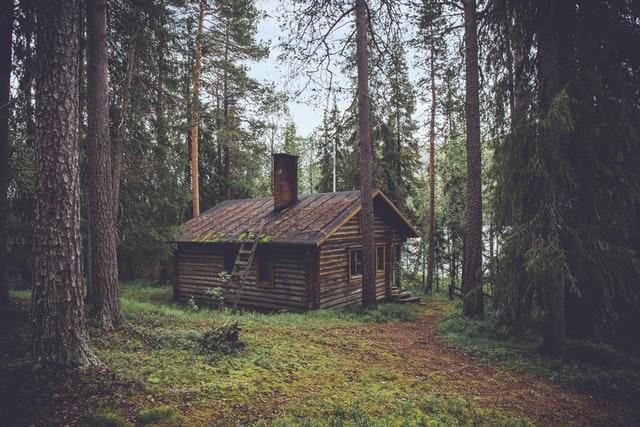
In his book, A Forest Journey, John Perlin chronicles how the rise and falls of civilizations is closely linked with the management or mismanagement of energy resources -- for most of the world, wood. Civilizations have risen and fallen due based on the availability of wood as a resource to build homes, cook food, keep them warm, enable commerce, and power their culture. As we continue into the 21st century and an increasingly growing global population competes for finite resources we must consider the sustainability of our choices.
Energy production and consumption sustains life on earth and drives the global economy. We use energy to cook, to keep ourselves warm, to transport us from place to place, and to manufacture our goods. The world's economy or economic system is driven by fossil fuels which took millions of years to form. As the world population grows beyond 6 billion, we are consuming fossil fuels at an alarming rate. In the United States more than 90% of the energy comes from fossil fuels; and less than 5% from renewable resources. In order to maintain our way of life into the foreseeable future we need to be concerned about the sustainability of our energy resources. Fossil fuels are finite and will eventually depleted. In order to live sustainably we must first limit or make more efficient our energy consumption. Then we must explore sustainable alternative energy sources such as hydropower, nuclear power, and wind, solar, and geothermal energy.

The world's economy or economic system is driven by fossil fuels which took millions of years to form. As the world population approaches 6 billion, we are consuming fossil fuels at an alarming rate. In the United States more than 90% of the energy comes from fossil fuels; and less than 5% from renewable resources. In terms of human history, the fossil fuel event will be brief. After using fossil fuels for about 600 years we are probably on a permanent downward course in worldwide production of natural gas, at or just past the peak in the production of oil and within a few hundred years of reaching our peak in coal. If world energy consumption continues to grow at 2.8% the consumption of energy doubles from 336,000,000,000,000,000 BTU’s to 672,000,000,000,000,000 BTU’s in just 25 years.
World wood consumption is growing in parallel with world energy consumption. However, although wood accounts for roughly half of all the industrial raw materials produced in the world (by weight), only 4% of the energy needed to process these materials into useful products goes to wood. Wood is produced by trees in the forest using free energy from the sun, carbon from the atmosphere, and water from the ground. Wood is also an excellent insulator, further enhancing its energy efficiency.
We are now living in the Industrial and Information Ages simultaneously. We can use information technology to save energy. We can replace a transportation based economy with a communications based economy, saving massive amounts of fossil fuel. We can produce more from less: less raw material input, less energy, less waste, and less pollution. We can decrease the amount of energy intensive non-renewable resources we use as we make a smooth transition from the Industrial to the Information Age. When it come to living sustainably on this planet, few topics are as important as energy.
Solar energy warms the earth, causes evaporation of water, brings rain, and drives the winds. Solar energy is absorbed by the chlorophyll in plants and converted to chemical energy in a process known as photosynthesis.
Photosynthesis produces all of the oxygen in the atmosphere. The fundamental task of photosynthesis is to make it possible for cells to convert carbon dioxide and water into carbohydrates with energy absorbed from the sun. In green plants, chlorophyll molecules collect light energy and funnel it to a reaction center. Photosynthesis Center Link
Respiration is the reverse of photosynthesis. In respiration, glucose is consumed, with energy, water and carbon dioxide produced. We breath in the oxygen produced by healthy growing tree and we breath out (respire) carbon dioxide and water.
A chemical can be part of a living thing at one moment and part of the non-living environment a moment later. Chemicals move in and out of living organisms and are used again and again. Some of the carbon atoms forming a protein molecule in your arm may have once been a part of a chicken liver, the hide of a dinosaur, or even a limestone formation. The kinds and amounts of chemicals in an ecosystem regulate the activities of the plants and thus the animals in that system. Maybe you have some atoms from Einstein or a redwood tree.
^ Top
< Temperate Forest Foundation Home